

When a home goods company tried to register “SWIFT HOME” for its pillows and sheets, Taylor Swift was not about to shake it off. The intense (albeit brief) trademark showdown between Swift and Cathay Home offers a front-row seat to how celebrity brand enforcement actually works and why Cathay ultimately walked away without a fight.
Background
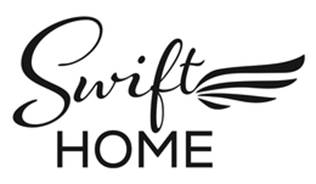
On May 5, 2025, Cathay Home, a New York City-based home goods company, filed to register SWIFT HOME & Design (U.S. Serial No. 99/170,193) for bedding and home goods-including decorative pillows, mattresses, mattress toppers, bath towels, bed blankets, comforters, duvets, pillowcases, and sheet sets using the following design:
Enter Taylor Swift’s licensing arm, TAS Rights Management, LLC, which filed an opposition on February 11, 2026. TAS is the authorized licensee of Swift’s trademark rights and rights of publicity, and it came armed with an arsenal of incontestable federal trademark registrations covering overlapping products. Most notably, TAS owns U.S. Trademark Registration No. 4,514,997 for TAYLOR SWIFT (stylized) covering bed blankets, bed linens, and blanket throws (in use since December 2012), and Registration No. 5,529,441 for TAYLOR SWIFT covering pillows, accent pillows, bed pillows, novelty pillows, and throw pillows (in use since November 2015). The opposition emphasized what TAS called Swift’s “extensive goodwill and recognition throughout the United States,” pointing to her fourteen GRAMMY Awards, her four Album of the Year wins, and her designation as TIME magazine’s 2023 Person of the Year. TAS Rights Management, LLC v. Cathay Home Inc., Notice of Opposition at ¶¶ 2-3, Opp. No. 91305120 (TTAB Feb. 11, 2026).
The Arguments
TAS laid out two main claims. First, under Section 2(a) of the Lanham Act, TAS argued that Cathay’s SWIFT HOME mark falsely suggests a connection with Taylor Swift because when most people hear “Swift,” they are not thinking about speed. TAS asserted that consumers would “immediately recognize the name ‘SWIFT’ as identifying the Artist” and that Cathay was attempting to “trade on the substantial goodwill and recognition that the Artist enjoys.” Id. at ¶¶ 11-21.
Second, under Section 2(d), TAS put forth a likelihood of confusion claim, emphasizing that the goods Cathay sought to register (pillows, bed linens, comforters) are “the same as or substantially related to” the goods already covered by TAS’s registrations. Id. at ¶ 28. But the real likelihood of confusion was the visual similarity. TAS noted that the cursive “SWIFT” in Cathay’s logo is “highly similar to the manner in which ‘SWIFT’ is displayed” in TAS’s own stylized marks, a “custom font intended to approximate the Artist’s handwriting”:
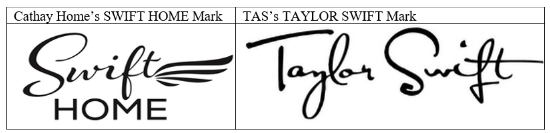
Id. at ¶ 29.
The Result
Once the opposition was filed (and widely publicized), Cathay expressed its intent to withdraw its application. The company publicly stated that the mark had not been used in commerce and was not critical to its business. Reading between the lines, the pressure from Swift’s team, combined with the uncomfortable reality that Cathay’s cursive “Swift” could lead consumers to believe they were buying officially endorsed Taylor Swift bedding, made walking away the smarter play.
Implications
For celebrities and entertainment brands, this case reinforces that Section 2(a) false association claims remain a powerful tool-especially when an applicant’s stylized mark evokes someone’s signature, handwriting, or overall brand image. For consumer products companies considering a famous name (even unintentionally), it serves as a warning: if your goods overlap with a celebrity’s existing registrations, expect aggressive policing. And if your branding could imply endorsement, that raises an even bigger red flag. TAS strengthened its case by attaching screenshots from Cathay’s “Brands and Licensing Partners” webpage, which lists an extensive roster of third-party brand deals (see https://www.cathayhome.com/pages/brands). The implication? Consumers might reasonably assume “SWIFT HOME” was just another celebrity licensing partnership on that page, exactly the kind of confusion TAS set out to prevent.